
Mental Toughness
What is Mental Toughness?
Mental Toughness is a flexible personality trait that determines, in large part, how individuals respond when exposed to stressors, pressure, and challenge, irrespective of the prevailing situation.
It describes the mindset that an individual adopts in everything they do and is closely related to qualities such as character, resilience, and grit. Understanding your mental toughness provides critical insight into performance, wellbeing, positive behaviour, and personal aspirations.
The 4Cs Framework of Mental Toughness
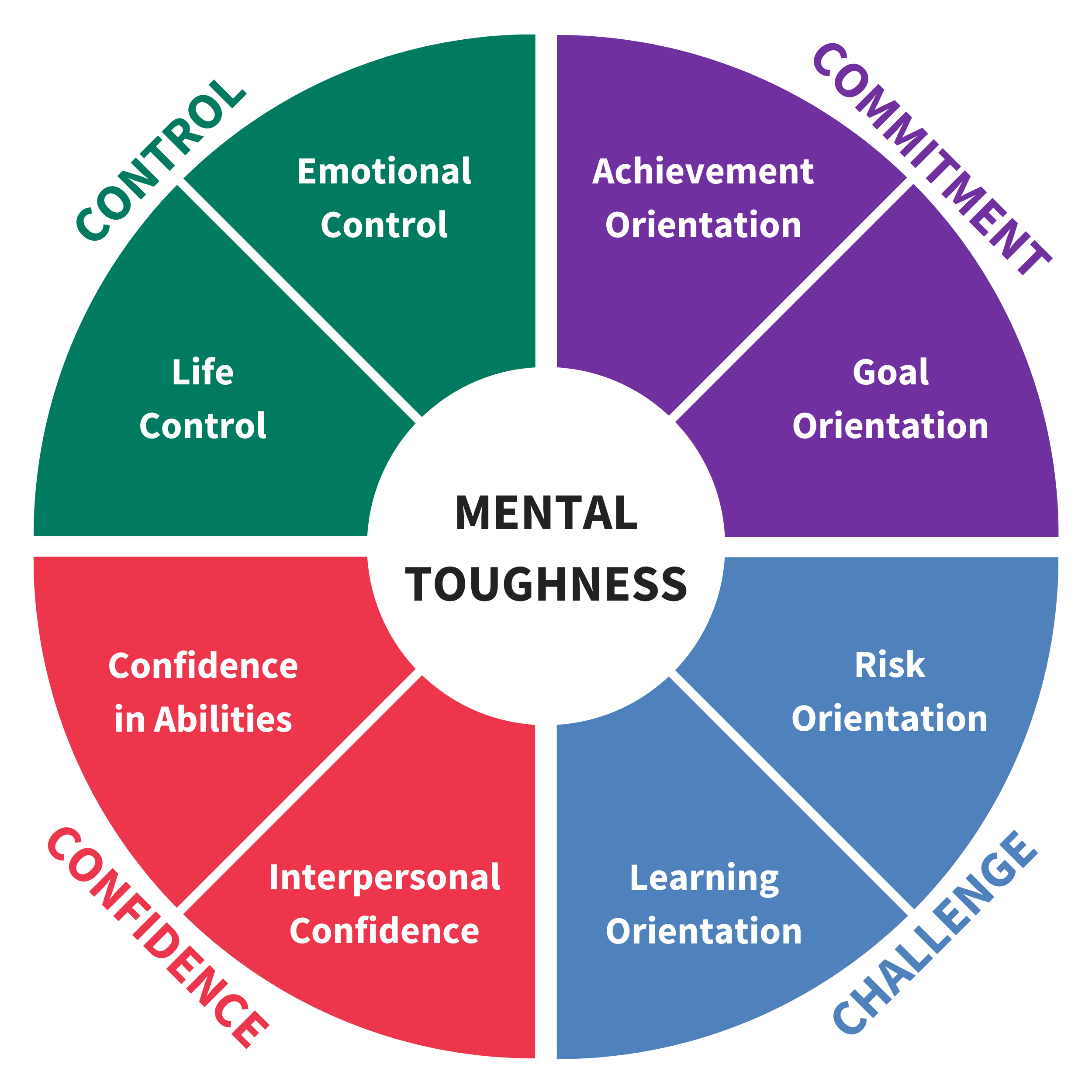
Research initially led by Professor Peter Clough identified the four core components of mental toughness, known as the 4Cs: Control, Commitment, Challenge, and Confidence:
- Control: A person’s belief in their ability to manage themselves, their lives, and their circumstances effectively, in terms of their belief that they can achieve most or all of what they need to achieve. It reflects their sense of self-worth.
- Commitment: This is the extent to which you know what you should do and why you should do it and make every effort to do it.
- Challenge: The extent to which individuals see change, adversity and new experiences as opportunities rather than threats.
- Confidence: The extent to which individuals have the self-belief in their abilities to successfully complete tasks that others may consider too difficult.
Further academic research shows these 4Cs break down into 8 independent factors. We can measure this with the MTQPlus.
Why Mental Toughness Matters
Studies across occupational, educational, health, and sports settings consistently show that higher levels of mental toughness correlate with:
-
Performance: Explaining up to 25% of the variation in individual performance in terms of productivity and quality.
-
Wellbeing: Supporting greater contentment, better stress management, and lower vulnerability to anxiety and bullying.
-
Agility & Positive Behaviour: Fostering a “can-do” attitude, greater adaptability, and personal accountability.
-
Aspirations: Encouraging higher career ambitions and a willingness to manage risk effectively.
How We Can Help
Measure
Most personality measures focus on assessing behaviours (how we act) and attributes (how we feel) – the MTQPlus and MTQ48 explore “how we think” – a key driver of behaviour and emotions. Both are normative measures; the test results for an individual are compared to a global norm group. This provides the capability to assess change and growth reliably.
Analyse
Develop
It is possible to create self-awareness about one’s level of Mental Toughness and, through this, to optimise a person’s performance, agility and wellbeing. AQR and its partners have created options for development in individuals and teams through our coaching and development programmes.
Frequently Asked Questions
What is the research behind your assessments?
There are now 300+ and rising peer-reviewed academic papers which support the concept. It is estimated that 75% of all research around the world on mental toughness is now focused on the 4Cs model. We take great pride in evidence-based practice and supporting our high-quality assessments.
Do you recommend books on Mental Toughness?
Yes! All the books recommended can be purchased through our online shop.
Developing Mental Toughness, Developing Mental Toughness in Young People, Developing Resilient Organizations, Developing Employability and Enterprise, Leadership in Coaching and Psychometrics in Coaching.
How long does it take to become a licensed user?
Our online-only licensed user training takes around 10 hours to complete at your own pace. Our blended programme takes around 16 hours, including a full day of training with one of our tutors over a video call.
Can I purchase a Mental Toughness Questionnaire without becoming a licensed user?
Yes. Bureau service involves AQR handling all of the administration of the tests. However, if you are planning on testing and providing feedback to several candidates, it is more cost-effective and easier to handle feedback if you are a licensed user.
Become a Mental Toughness Practitioner Today
Are you interested in joining our global network of licensed users? Or simply assessing and developing yourself?