
Do we spend too much time on burnout when fatigue management is an equally important factor in managing wellbeing and safe practice?
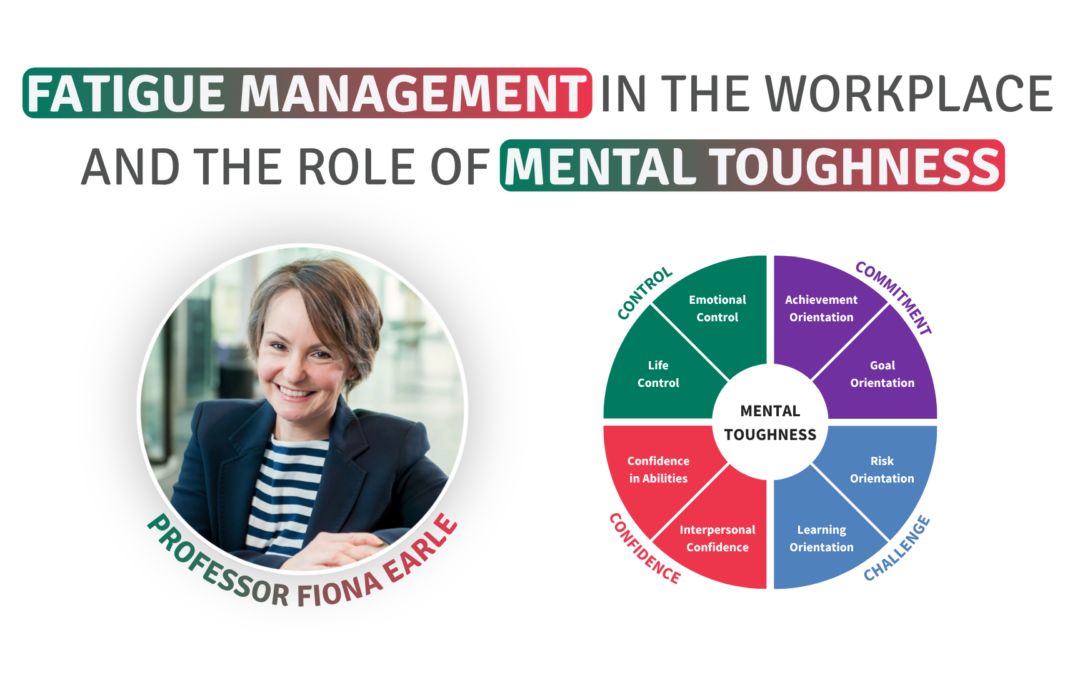
On the 7th October, AQR International ran its monthly CPD event. The topic was fatigue management, delivered by Professor Fiona Earle, a consultant who is a leading authority on the subject both as a researcher and a practitioner. The session was an eye-opener.
She defined fatigue as “a state that develops in response to effortful engagement in work or sleep disruption.” In other words, a feeling of physical, mental, or combined exhaustion and lack of energy that is more severe than normal tiredness and does not go away with rest.
It is caused by mental demands, time pressure, physical and emotional demands, and sleep deprivation. Many workplaces generate exceptional levels of these demands, especially settings where there are high and sustained levels of stressors, such as first responder services, offshore work, work with hazardous materials, professional services, shift work, or prolonged activity.
The session provided examples of offshore workers spending time on platforms working 12-hour shifts, construction workers operating in challenging settings, and maintenance workers who restore energy supply networks in remote and harsh conditions.
According to the Royal College of Psychiatrists, at any given time, one in five people feels unusually tired, and one in ten experiences prolonged fatigue.
This results in a number of potential outcomes: tiredness, impaired problem-solving and decision-making, increased risk-taking, and an aversion to making further effort.
This has significant consequences for wellbeing, mental and physical health, performance, and safety in work practices. The risk of an accident rises significantly with tiredness. In safety-critical operations, implementing proactive fatigue management is a major priority, but it applies equally to driving on a long journey or rushing to meet a deadline.
Fatigue and burnout are related but distinct, and understanding this difference is important for identifying the best approach for prevention and recovery.
Where fatigue is a state of extreme tiredness that can be resolved by rest, stress management, and attending to workplace conditions, burnout is a state of complete mental and physical exhaustion caused by the individual’s response to stressors. Fatigue can often be a step before burnout.
Mental toughness is a personality trait that explains our default, unconscious mental responses to stressors, pressure, and opportunity.
View accessible text version: The 8 Factors of Mental Toughness
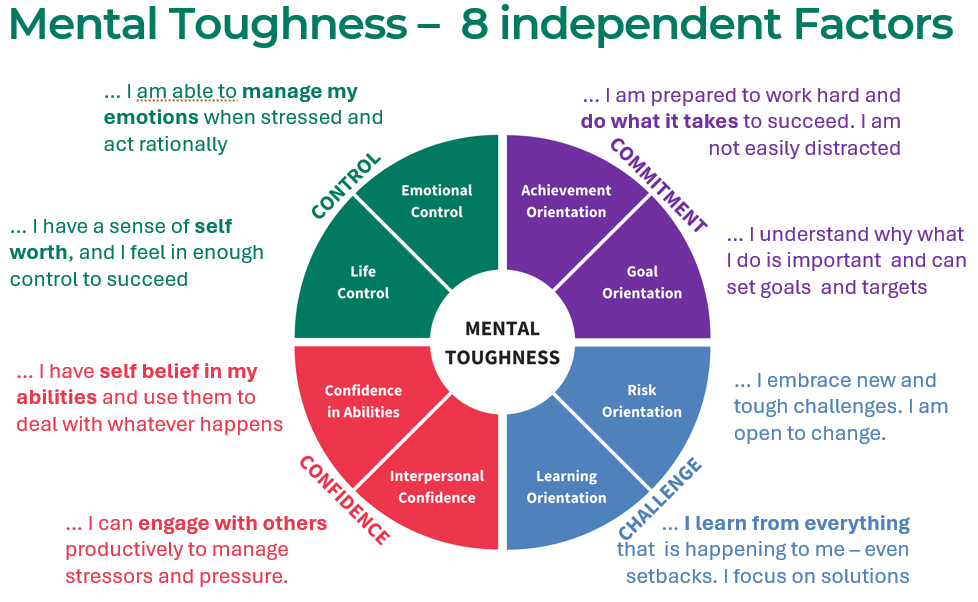
Mental Toughness – 8 Independent Factors
The Mental Toughness model is made up of four main categories (The 4Cs), each consisting of two independent factors:
1. CONTROL
- Emotional Control: “… I am able to manage my emotions when stressed and act rationally”
- Life Control: “… I have a sense of self worth, and I feel in enough control to succeed”
2. COMMITMENT
- Achievement Orientation: “… I am prepared to work hard and do what it takes to succeed. I am not easily distracted”
- Goal Orientation: “… I understand why what I do is important and can set goals and targets”
3. CHALLENGE
- Risk Orientation: “… I embrace new and tough challenges. I am open to change.”
- Learning Orientation: “… I learn from everything that is happening to me – even setbacks. I focus on solutions”
4. CONFIDENCE
- Confidence in Abilities: “… I have self belief in my abilities and use them to deal with whatever happens”
- Interpersonal Confidence: “… I can engage with others productively to manage stressors and pressure.”
An individual’s mental toughness profile can act as a moderator of fatigue. Challenge, control, and commitment are likely to be positive and helpful moderators of the relationship between stressors and the development of fatigue; they all serve to help us cope well with demands.
However, highly committed, highly confident individuals are also likely to keep going despite warning signs that it is no longer safe to continue.
What this means for effective fatigue management is that mental toughness is a significant influence on decisions about fitness for work—both our own fitness and that of others. Self-awareness about our unconscious mental responses to what we do is fundamentally important. It guides both prevention and recovery.
As we know, high mental toughness profiles are not universally positive. Understanding the implications of the different factors is key. People with high mental toughness may (in some contexts or conditions) be more susceptible to risky behaviour and working beyond what is safe. Understanding our response to stress and fatigue risks is vital in safety-critical roles.
It is essential to organise the workplace to minimise the risk of fatigue. Self-awareness of a person’s mental toughness profile plays a significant part in effective fatigue management and risk reduction.
For more information about fatigue management, mental toughness, and their implications for workplace wellbeing, contact AQR International today.
