What has changed, if anything? We can do better.
Leadership as a topic has been high on the agenda for a long time. It features prominently on the World Economic Forum list of the 10 most important skills for the 21st Century. But the one thing we are not short of is leadership models and advice.
Most are behavioural models—leadership is something we demonstrate. Many appear to overlap or look at the same aspect of leadership from a different perspective.
It is no wonder that Augier & Teece made their observation. Provoked by a discussion with the then UK Institute of Leadership and Management, AQR International, together with Professor Peter Clough, launched a major study to examine these issues.
Examining academic and practitioner leadership models from around the world, the first step was to analyse the models by stripping them down to their bare components. This revealed that all the models had roots in one or more of 6 common factors. The results were extremely interesting.
The 6 Scales of Leadership Style
The study indicated that there is no particular combination of factors which correlated uniquely with performance. An optimal leadership style is situational. Individuals also did not behave according to their preferred style, but to their adopted style. They tended to conform to a prevailing leadership style that, instead of being flexible, tended to be rigid.
The 6 scales emerged as below:
Most popular leadership models have their roots in one or more of these six specific scales. An individual’s leadership style emerges from a combination of these factors.
Defining Leadership
Thousands of definitions exist, yet most focus on two themes: leadership is about improving performance, and achieving this through followers without detriment to their wellbeing.
There is an obvious value in looking at leadership in this way.
Leadership Core Competencies
Further analysis revealed that 3 overarching competencies emerged from the study:
-
Determination to Deliver: This describes a sense of purpose with a single-minded focus on success. For all involved, most satisfaction is derived from this.
-
Engagement with Individuals: This describes enabling capability, confidence, and resources to allow individuals to perform and fulfil themselves.
-
Engagement with Teams: The focus is on cross-functional team working—the “one team” approach—supporting people to work together across the organisation.
Assessing Leadership Style with ILM72
An important and valuable by-product of the work carried out has led to the development of a normative questionnaire (ILM72) which measures individuals and organisations in terms of the six specific scales (style) and the three global scales (core competencies).
What About the Mental Approach to Demonstrating Leadership?
The work described above makes sense of what is visible. Working on behaviour is important because behaviour addresses what people do and how they do it. However, it is just as important to address the “why” questions: Why do leaders respond the way they do?
A significant part of the answer lies in understanding the default unconscious mental approach that people—including leaders—adopt when dealing with people and events, especially when a swift response is needed.
This is the Mental Toughness concept, and it brings an important dimension to understanding leadership. Supported by well over 1,000 peer-reviewed research papers, this psychological concept explains a person’s unconscious mental response to challenge, opportunity, setback, and threat, irrespective of circumstances.
It consists of 8 independent factors (grouped under the 4Cs: Control, Commitment, Challenge, and Confidence) and is the single biggest influence—directly and indirectly—on behaviour. Indirectly, it also influences all the other factors, internal and external to the leader, that shape behaviour.
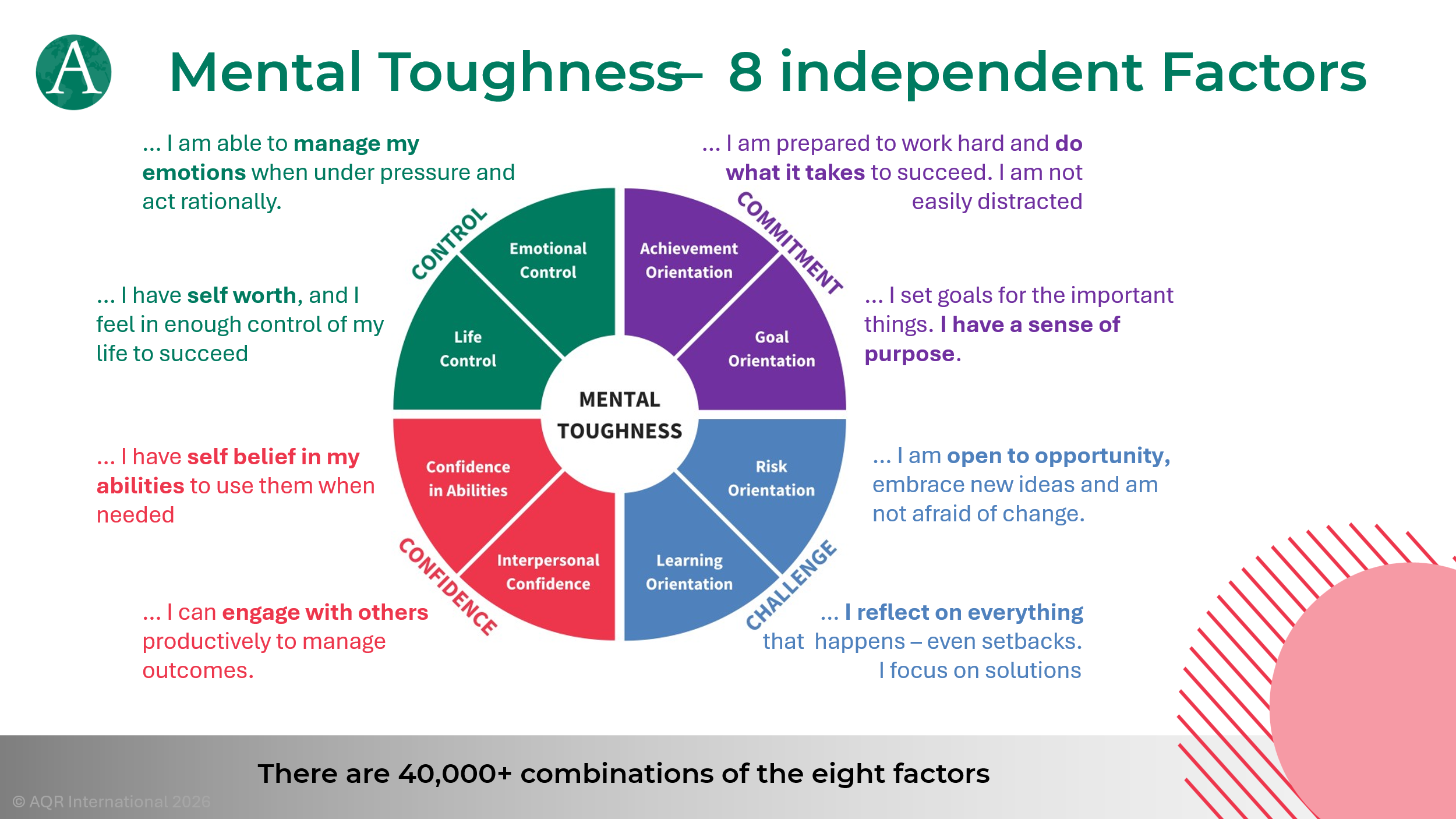
View full text breakdown of the 8 Mental Toughness factors
- Control – Emotional Control: “…I am able to manage my emotions when under pressure and act rationally.”
- Control – Life Control: “…I have self worth, and I feel in enough control of my life to succeed.”
- Commitment – Achievement Orientation: “…I am prepared to work hard and do what it takes to succeed. I am not easily distracted.”
- Commitment – Goal Orientation: “…I set goals for the important things. I have a sense of purpose.”
- Confidence – Confidence in Abilities: “…I have self belief in my abilities to use them when needed.”
- Confidence – Interpersonal Confidence: “…I can engage with others productively to manage outcomes.”
- Challenge – Risk Orientation: “…I am open to opportunity, embrace new ideas and am not afraid of change.”
- Challenge – Learning Orientation: “…I reflect on everything that happens – even setbacks. I focus on solutions.”
There are 40,000+ combinations of the eight factors. (© AQR International)
It is not hard to see how each of these factors maps to core leadership competencies.
Conclusion
The challenge is to grasp more effectively what leadership is and what it can do for the organisation—and then to assess and develop it in a more complete and robust way.
For more information about assessing leadership competencies and leadership style through the ILM72 measure, contact headoffice@aqr.co.uk.
