You first need to understand it. Mental Toughness really helps.
Team Working is important. Arguably, it is the core challenge for leadership. As Tomas Chamorro-Premuzic puts it: “Can you convince people to collaborate effectively to accomplish a common goal; can you persuade people to set aside their individual… instincts so they can achieve something they would not be able to achieve individually?”
Getting this right can be the key to unlocking discretionary effort from a group of people—that super productivity that arises from a motivated team who deliver more and don’t see it as especially demanding, but as exciting and fulfilling.
Looking Beyond Surface Behaviour
The mental toughness concept and the MTQPlus psychometric provide the lens through which team dynamics can be understood and assessed. Mental toughness describes that invisible aspect of personality that determines how people respond mentally when events occur. Moreover, it is the default response we are looking at—the habitual mental response that influences our behaviour to such a great extent.
It explains the “fight or flight” response. Two people equal in every way behave differently when confronted by a sabre-toothed tiger. It is rooted in their instinctive mental response.
Mostly, team-building programmes are enjoyable, but evidence for their long-term impact is limited. When focused solely on behaviour, they explore what the team and team members are doing, often in two dimensions: does this behaviour help team functioning, and do people help and support each other?
Some of this is useful, yet it only addresses part of the picture.
Asking “Why” Before “How”
The key question in optimising team working begins with “why”, as it does for all aspects of people and organisation development: “Why does this team function the way it does?” That means exploring where behaviour comes from—and that is where mental toughness comes in.
Once we get a good answer to the “why” question, we can build a response to understand: “How can we improve team working?”
Team working is more complex than most realise, with many factors to consider. This might include situation, resources,realistic expectations, interest, and motivation. At its heart, however, it is about people, where there are two perspectives to consider: the individual and the collective. Both bring a degree of complexity to the picture.
The Power of Individual and Shared Self-Awareness
For each team member, self-awareness about their mental toughness profile can provide deep insight into why they respond to what happens in the team, and why that impacts both their own behaviour and the way they approach other team members. Once they see that, can they optimise it?
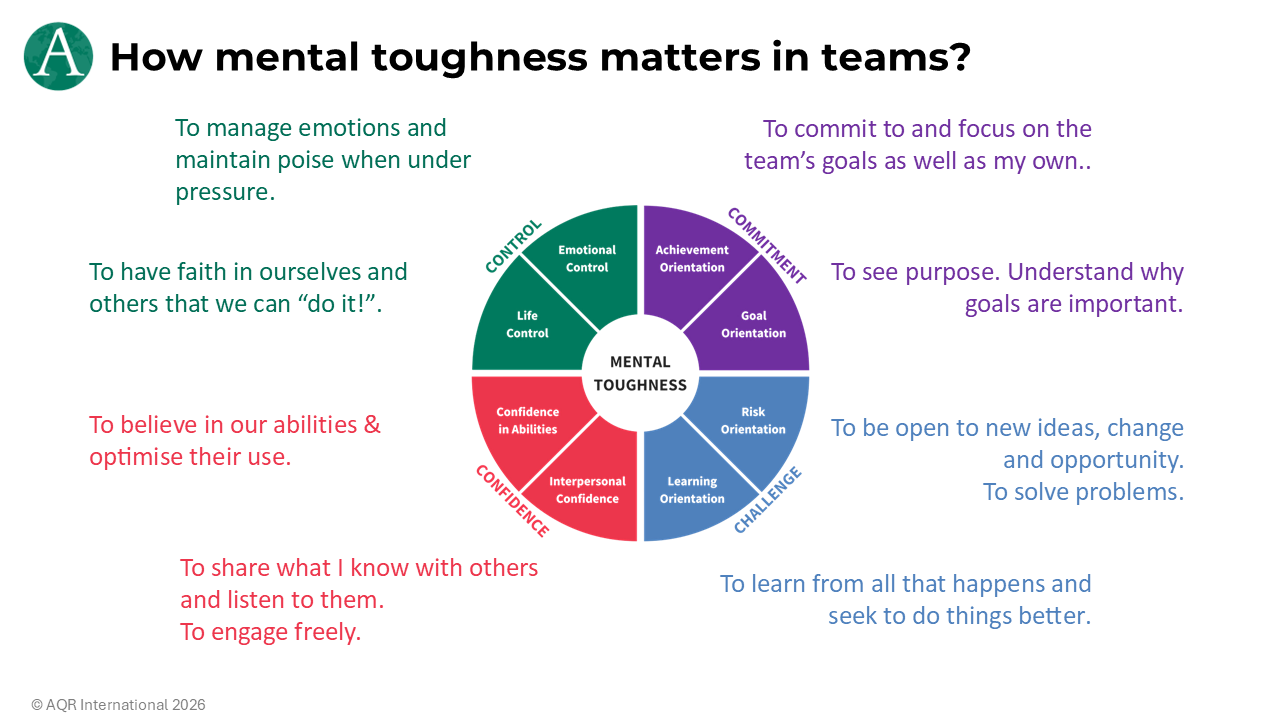
How the 4Cs and 8 factors of Mental Toughness support individual and collective team performance. © AQR International 2026.
View accessible text breakdown: How Mental Toughness matters in teams (4Cs & 8 Factors)
Control
- Emotional Control: To manage emotions and maintain poise when under pressure.[cite: 1]
- Life Control: To have faith in ourselves and others that we can “do it!”.[cite: 1]
Commitment
- Achievement Orientation: To commit to and focus on the team’s goals as well as my own.[cite: 1]
- Goal Orientation: To see purpose and understand why goals are important.[cite: 1]
Challenge
- Risk Orientation: To be open to new ideas, change, and opportunity, and to solve problems.[cite: 1]
- Learning Orientation: To learn from all that happens and seek to do things better.[cite: 1]
Confidence
- Confidence in Abilities: To believe in our abilities and optimise their use.[cite: 1]
- Interpersonal Confidence: To share what I know with others, listen to them, and engage freely.[cite: 1]
Sharing this information in teams taps into something really valuable. Team members can understand each other better: “I can now understand how others approach our team tasks in their minds and how I perceive the way they see me, and they can understand my behaviour, and I see them and better understand their behaviour.”
This provides a fundamental insight into why we respond to each other the way we do and where those interactions can be improved. There is now the potential for a robust solution.
What This Series Will Explore
In this series, we will look at team working from several different perspectives, each using the mental toughness framework and measure as a means of understanding every angle and how they connect. Upcoming articles will explore:
- Optimising team working
- What good teams do and why mental toughness matters
- Communications in teams – building psychological safety
- Team leadership
- What leadership style means for a team
- Team toughness
Chamorro-Premuzic is correct: collaboration matters. True optimisation means improving the contributions each individual makes, as well as refining the way team members interact to get the best out of each other.
To do this, you need to dig deeper than simply looking at behaviour. It’s not easy, but it can be done.
