
If you are looking to elevate your coaching practice, your primary purpose is to help your clients understand what it is about their responses to events that work well or work less well for them.
Most coaching relationships examine their clients’ behavioural patterns. This is useful and addresses “what happens when …”, but it is only part of the picture.
If you want to transform your coaching approach, the key question at the heart of coaching is “why do I behave the way I do?”. Looking at behaviour alone cannot do that. Behaviour is complex and arises from many factors.
The most important of these is the mental toughness concept, which is a well-evidenced aspect of everyone’s personality and which is the biggest direct and indirect influence on everyone’s behaviour.
It is defined as “A personality trait that explains, in large part, how individuals respond mentally when exposed to stressors, pressure, opportunity and challenge. irrespective of the prevailing situation.”
It is rooted in leading-edge psychological theories.
Unlike behaviour that can be observed, mental toughness is in your head. It is largely “invisible”.
How Mental Toughness Can Elevate Your Coaching Practice
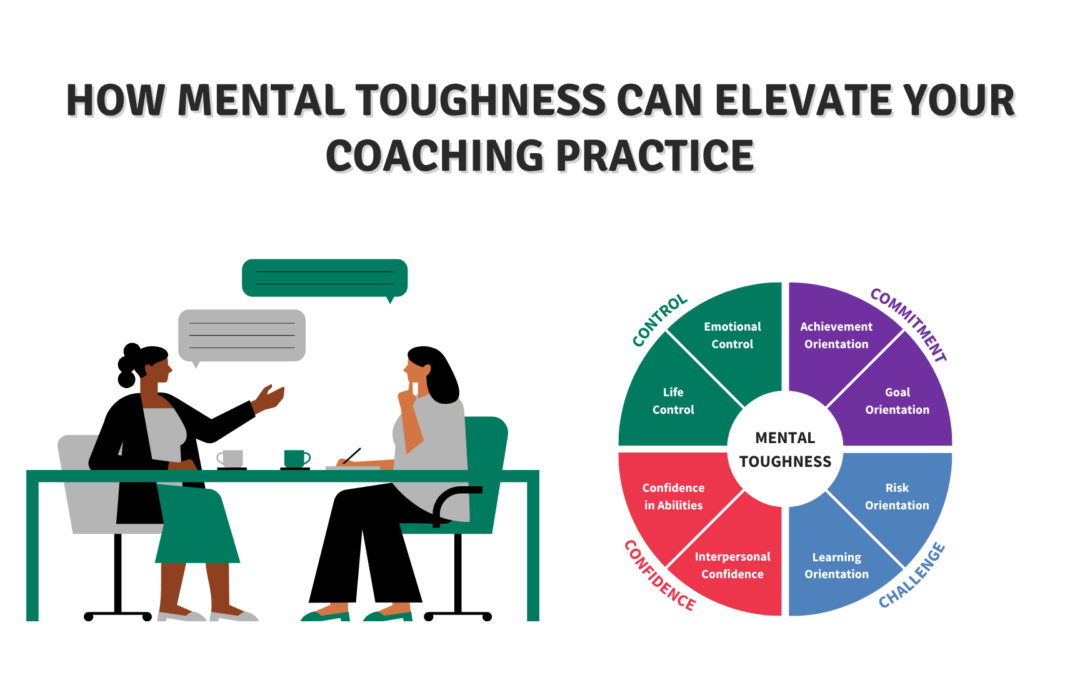
25 years of serious academic research has established that it consists of four elements (called the 4Cs) and eight independent factors.
The 4Cs explain a client’s default mental approach to control, Commitment, Challenge and Confidence. The eight factors dig deeper still.
In turn, this means that there are over 40,000 possible combinations, meaning we are able to assess and understand each client to a remarkable degree of detail.
This enables customisation – addressing the client’s fundamental and specific issues.
There are several unique features that are valuable for coaches.
Mental toughness is a spectrum with mental toughness at one end and mental sensitivity at the other. Terms like “good” or “bad”, strong” or weak” are not appropriate here. There are advantages and disadvantages for each point on the spectrum. This makes for productive conversations.
Self-awareness, not of behaviour, but of the underlying mental approach, is fundamentally important here. The more mentally tough can struggle without it, and the more mentally sensitive can thrive with it
For this reason, the concept and the psychometric measure avoid labelling people.
The MTQPlus psychometric enables the assessment of the eight factors, and the reports provide guidance on interpretation. Helping to make the invisible, visible. There are two levels of training available – a foundation programme and an advanced practitioner programme.
Most development approaches are well known to coaches and fit very well with this concept. Self-awareness and the understanding this brings also help the development process.
Because the MTQPlus is a normative measure, it can bring a data-based approach to development, enabling evaluation of the impact and effectiveness of interventions.
As well as being inherently related to individual behaviour, it is also centrally related to leadership and teamwork, bringing a fresh perspective to each area in a way that is systemic.
To learn about the mental toughness concept in more detail, see “What is Mental Toughness”. It could elevate your coaching practice.
