How self-awareness about mental toughness can make that difference.
In adolescence, X was a promising young athlete. Sufficiently good for her coaches to believe that she could become an elite athlete in time. She also aspired to do well.
However, over-ambitious parenting and overzealous, highly demanding and critical coaching produced the opposite outcome. X’s self-esteem plummeted and she withdrew from her sport.
Her self-esteem was sufficiently low for her to seek support for severe anxiety and depression. Treatments offered included a regime of drugs and medicine which lasted for seven years.
Then, X sought alternative support. Drugs did not seem to work. Her condition wasn’t improving.
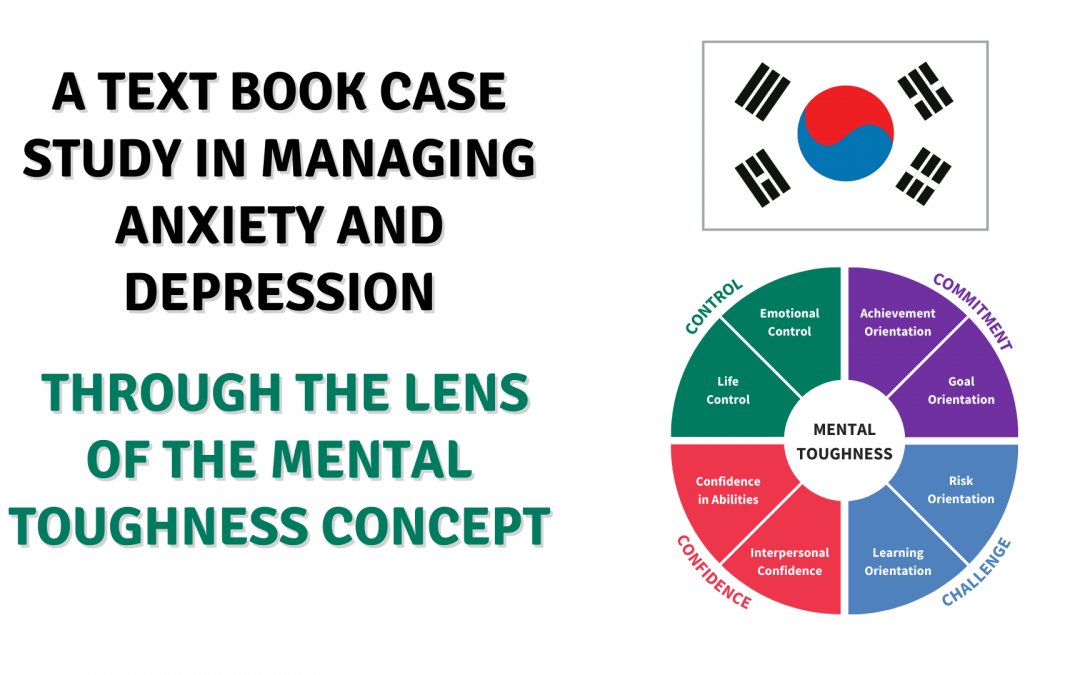
X found a licensed mental toughness practitioner who has expertise in mindfulness meditation and anxiety reduction techniques. X completed the MTQPlus psychometric measure.
At that point, her mental toughness profile, shown below on the left, revealed a succession of very mentally sensitive scores on most of the 8 mental toughness factors. The single exception being a significant mentally toughness score on goal orientation indicating a strong sense of purpose and a liking for working to goals and targets.
The mental toughness coach began working regularly with her, introducing mindfulness and anxiety reduction techniques. X practised these diligently. Two months into the programme X was reassessed using the MTQPlus measure. The new profile is shown below on the right.
A pleasant surprise was that the Sten scores for all eight factors had significantly shifted to a level that was slightly above average for an adult. This suggested that X was now be able to deal with her anxiety and depression more effectively than before. Medication had been suspended during this period of intervention and has since never restarted.
X’s own view is that her self-esteem had been restored and for the first time in a very long time she was feeling sufficiently confident to insist that she no longer needed medical support.
In one sense this is an unusual example. It is very rarely the case that we can see such a significant shift in a mental toughness profile in such a short time.
It may be that, as an aspiring athlete, X had originally possessed a reasonable level of mental toughness. It is possible that adverse treatment at the hands of her parents and coaches resulted in a significant deterioration in her self-esteem.
This has now been restored through the lens of the mental toughness concept that enabled both diagnosis of her mental responses to events as well, creating vital self-awareness with X, as helping to direct specific appropriate interventions that worked for her.
The challenge, of course, is to ensure that this is sustained. 12 months later, indications suggest this will be the case.
X has, in a sense, gone full circle. She is now completing training as a mental toughness practitioner and coach. She intends to bring her experience and newfound expertise to support and develop others.
It needs to be said that for most people who wish to change their mental toughness, this level of change is exceptional. It is certainly possible to develop a level of mental toughness over a period of 12 to 24 months, and for this to make a difference to wellbeing and to performance and for it to be sustained into the future.
However, this case study does illustrate what a willing and committed client can achieve with the application of the mental toughness concept and carefully directed and customised interventions.
Illustrating another aspect of the wide range of applications for the mental toughness concept and measure.