
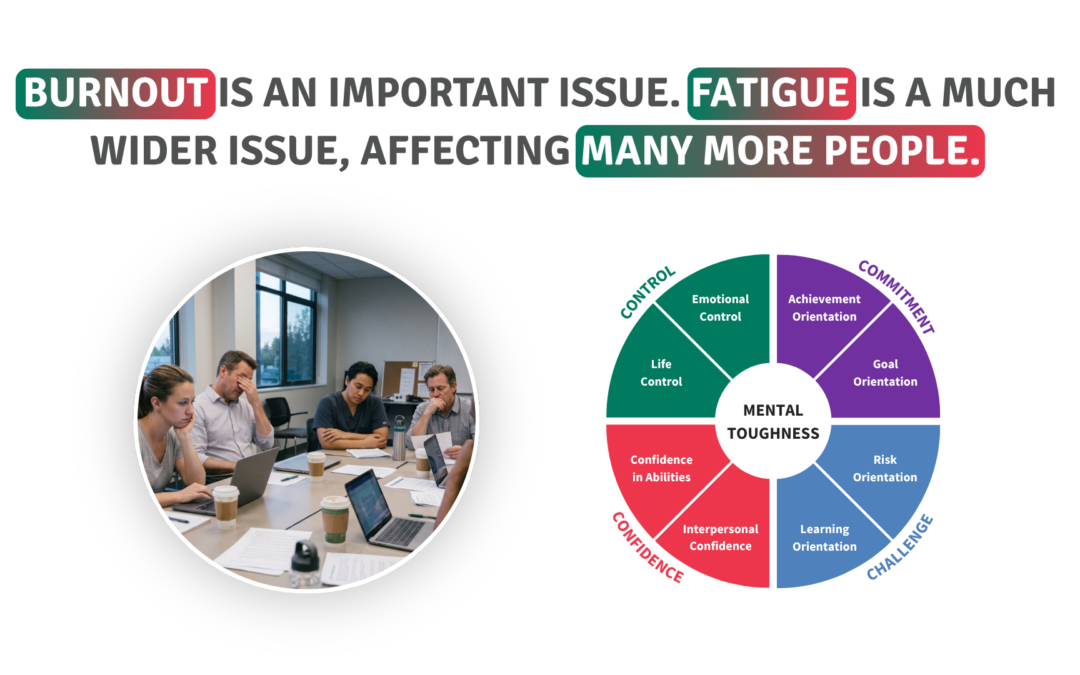
We need to pay much more attention to this.
According to the UK Health and Safety Executive (HSE), workplace fatigue is a major safety, health, and economic issue. It matters for personal health and wellbeing too.
According to the UK Royal College of Psychiatrists, about 20% of people (1 in 5) feel unusually tired at any given time, while roughly 10% (1 in 10) experience ongoing, prolonged fatigue. This won’t be true only in the UK.
Studies show fatigue is implicated in roughly 20% of accidents on major roads. It contributes to around 13% of workplace injuries, slows reaction times, and changes our focus and approach to decision-making. Fatigue and shift work have also been linked to the root causes of major historical incidents, including Chornobyl and Three Mile Island.
And yet, with understanding and a sound, evidence-based approach, managing fatigue at work is entirely achievable. Not just because it is a good thing to do in terms of engaging with people across all sectors, but because there are economic consequences too.
In the UK alone, the HSE has estimated the cost of work accidents is £115 million to £240 million per year, while broader productivity and health costs run into the billions.
Beyond Physical Labour: Mental and Emotional Demands
There is a common misconception that workplace fatigue is an issue predominantly for manual workers because their jobs have physical demands that many other jobs do not have. Manufacturing, engineering, construction, and transport are often referenced. However, many jobs have mental and emotional demands that are just as draining as physical demands.
Spirituality and purpose can also play a part. Feeling like you are doing something worthwhile is an important buffer against exhaustion—if that is absent, work can be incredibly draining.
Occupations and sectors where fatigue management is a particularly important factor to consider include:
-
Health Professionals – Nurses, doctors, paramedics
-
First Responder Services – Fire, ambulance, police, mountain rescue, etc.
-
Education and Social Services – Teachers, social workers, and students
-
Professional Services – Lawyers, accountants, consultants, etc.
-
Sport – Sportspeople, athletes, and coaches
-
Leadership – Crucially, leaders, managers, and employees across all sectors
How Mental Toughness Helps Manage Workplace Fatigue
The good news is that we understand a great deal about fatigue, and it can be managed. Researchers such as Professor Fiona Earle* have carried out leading-edge studies now translated into practical approaches to reduce and effectively manage workplace fatigue.
We also understand much more about the individual and their responses to everyday challenges. The Mental Toughness concept shines a light on how people approach tasks and what the implications are for fatigue and wellbeing.
The Mental Toughness questionnaire, MTQPlus, enables an assessment of a person’s subconscious approach to tasks and challenges. In turn, this helps to identify customised solutions for individuals and teams.
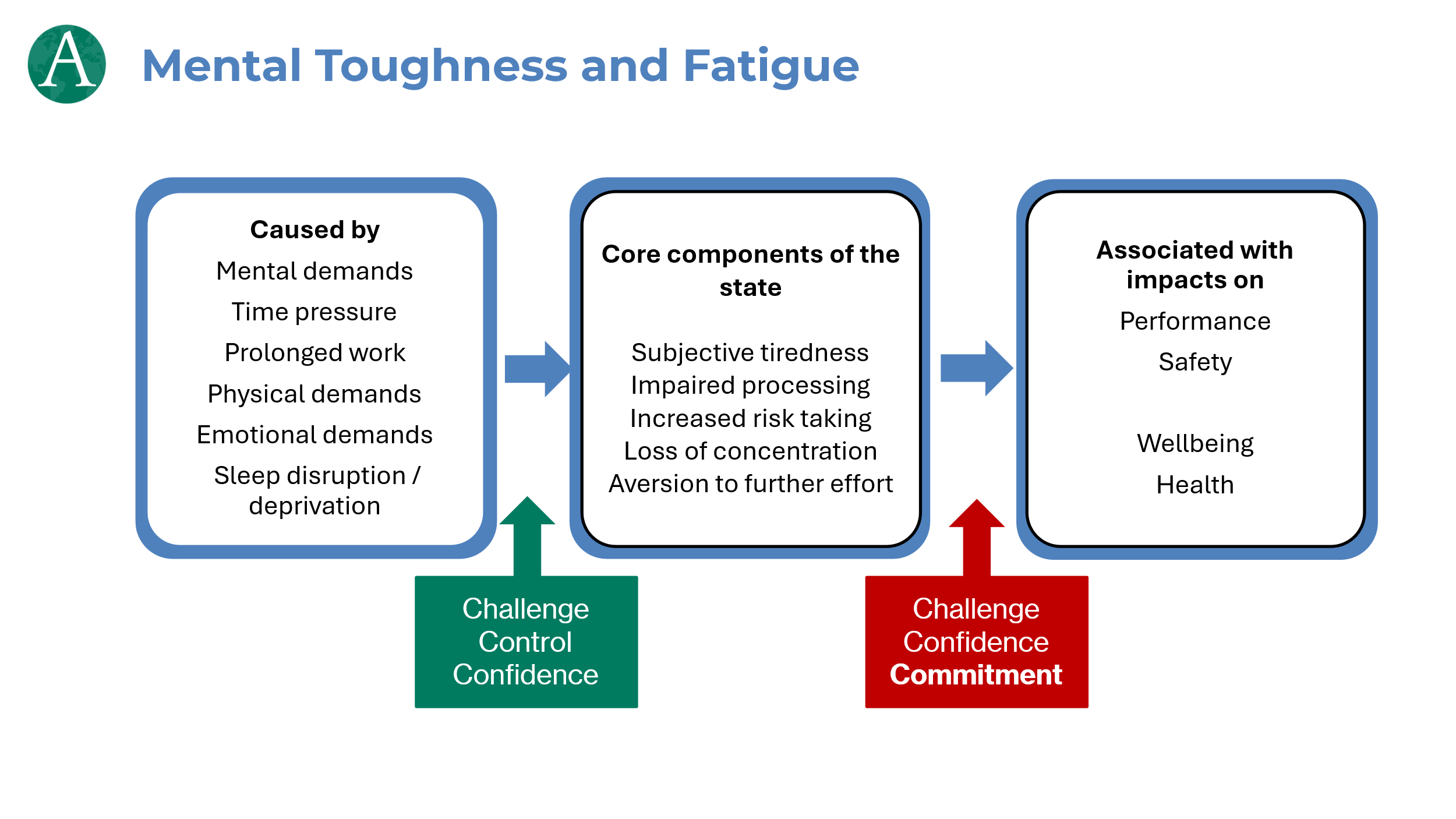
How Mental Toughness factors moderate the causes, core symptoms, and workplace impacts of fatigue.
Text alternative for the “Mental Toughness and Fatigue” diagram
Overview: This flowchart illustrates the progression from the causes of fatigue to its core symptoms and resulting impacts, highlighting where Mental Toughness factors intervene.
1. Caused by:
- Mental demands
- Time pressure
- Prolonged work
- Physical demands
- Emotional demands
- Sleep disruption/deprivation
Moderating Intervention (Transition 1): Between the causes of fatigue and the core components of the state, an upward arrow highlights three Mental Toughness factors: Challenge, Control, and Confidence.
2. Core components of the state:
- Subjective tiredness
- Impaired processing
- Increased risk-taking
- Loss of concentration
- Aversion to further effort
Moderating Intervention (Transition 2): Between the core components of the state and the associated impacts, an upward arrow highlights three Mental Toughness factors: Challenge, Confidence, and Commitment (with Commitment emphasised).
3. Associated with impacts on:
- Performance
- Safety
- Wellbeing
- Health
Join Our 2027 Online Workshop on Fatigue
In early 2027, together with Professor Earle, we will be running a half-day online workshop on managing fatigue. If you are interested, register your interest here. (Please note: there will be a small fee for attending).
*Earle, F., Hockey, B., Earle, K., & Clough, P. (2015). Separating the effects of task load and task motivation on the effort–fatigue relationship. Motivation and Emotion, 39(4), 467–476.
