
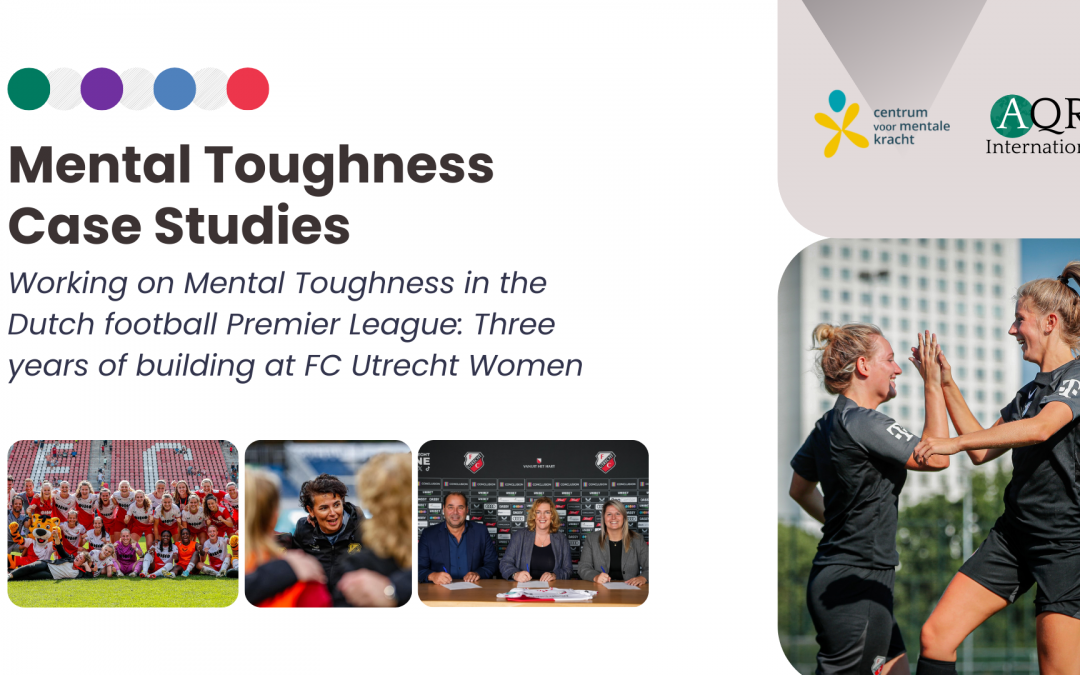
Working on Mental Toughness in the Dutch football Premier League: Three years of building at FC Utrecht Women
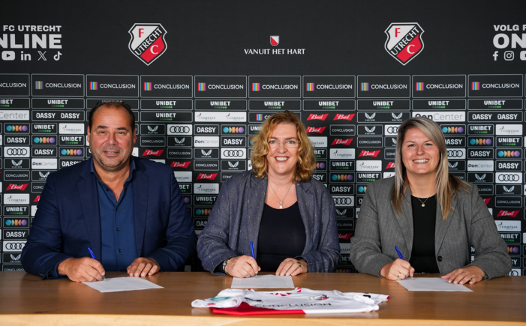
The Centre for Mental Toughness NL has been involved in a challenging project in the Netherlands for three years: a new women’s team in the Premier League for FC Utrecht. Twenty-three players who didn’t know each other. A staff of eleven people who had never worked together before. A budget that is less than half of the top clubs. And one ambitious trainer who took the lead. The goal was clear: to build a team that performs.
The plan was ambitious. Playing in the top six of the league in the first season. Anyone who has ever built a team knows that ambition is not enough. You need a program. You need structure. You need a high-performance culture. And you need mental toughness to deal with the challenges, stress and setbacks that come with top sport. Not as an extra. But as one of the foundations of the team.
FC Utrecht ended the 2024/25 season at 4th place in the Vrouwen Eredivisie. At this moment, they’re in 6th place with a team that lost some of the key players to other teams in recent months.
The beginning: measuring, not guessing
We started measuring. No assumptions. Data. The first MTQ Plus assessments gave us a clear picture of where we stood. The average score for mental toughness was around the average of “regular teams” outside of elite sport. That surprised us. We expected a group of top athletes to score more mentally tough. After analysis, it turned out that this could partly be explained by the composition of the team: many young players, little experience. This team was still at the beginning of the journey.
Two factors immediately caught our eye: learning orientation and interpersonal confidence. There, we saw that the values were much more mentally sensitive than the averages on other factors. And that was important information for the setup of our mental toughness program.
Learning orientation is the basis for achieving top performance: the focus on always learning from experiences to get better and better. And that is crucial to reach the top in sport.
Interpersonal confidence is also very important in a team sport. It is about the extent to which someone seeks interaction with others, dares to ask questions and stands up for herself.
In addition, confidence in abilities was something to work on.
And, of course, there were major differences between individual profiles. As expected, personal customisation in our coaching was important.
Building mental toughness
We knew where to focus and started with a combination of collective sessions and individual attention. We made the importance of Mental Toughness clear to the group, invited them to exchange experiences and to work on an open culture.
First, it was important that the trainer and staff understood mental toughness works and knew the model of the four C’s. That they recognise patterns in individual players and the team. The relative sensitivity in terms of interpersonal confidence meant that we had to pay close attention to the social side and safe interactions within the team. Social cohesion became a spearhead. Getting to know each other well. Having fun together. Dancing and making music. Playing silly games. Talk about religion. Accepting behavioural preferences from each other. Being able to be yourself. Open communication is key. Involve everyone. Giving space to think along. Offering opportunities to air ideas. And ensure that personnel changes, the departure of players or the recruitment of new ones do not lead to disruption in the group. This required conscious attention to the group process by the staff.
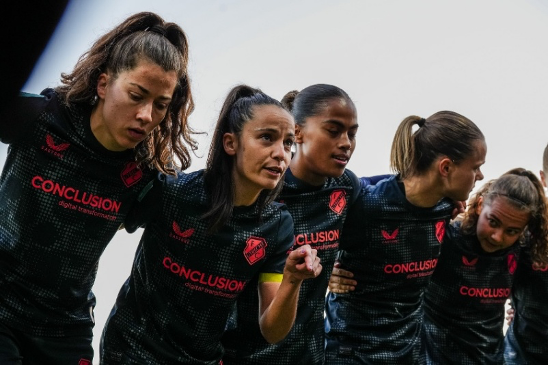 In addition, it was clear that working on learning orientation was important. For many players, it was not automatically the case that they learned from what they experienced. That has nothing to do with motivation. It is also separate from intelligence. It is a pattern that requires attention. This insight became crucial for the staff’s approach. It meant that we had to facilitate learning processes: reflection, feedback and explicitly linking experiences to growth.
And finally, we discussed building self-confidence in the team with the coaches. The question we repeatedly asked: “What did you do to help her build confidence today?” Also, we advised them to always use the names of the players on the pitch when giving positive feedback instead of “well done, ladies”.
We noticed that it helps to take examples from well-known coaches and players. In our programs, we regularly showed fragments of top players. We also used exercises that coaches such as Arne Slot use to train mental toughness. When we could say, “This is an exercise that Arne also does at Liverpool,” we saw that the willingness to participate was self-evident. It gave players the feeling that they were working on something that belongs in the top sports.
With several players, individual coaching was started in consultation with the staff, and tailor-made interventions were used based on the personal profile. We started with a small pilot group. Very different techniques were used from (sports) psychology, ACT, breathing techniques, religion, MBTI, etc.
And somewhere in this process, something beautiful emerged: a slogan. A word that the team shouts to each other when things are not going well on the field. “Unshakable.” It’s more than a word. A mantra. It’s a mindset. It reminds them that they will stay upright no matter what.
Year 2: Deepening and first results
The second year was different. The foundation was there. Now came the deepening. The team started talking more about their mindset and challenges. Ideas were shared. Feedback was given. Not always perfect, but open. The trainer saw the effect, and the intensive cooperation with her was one of the valuable experiences for the supervisors in the project.
 In addition to the sessions and conversations, we have actively worked on mental toughness on the training field every month. Not just talking but doing. Rain or shine. Players were given assignments that were relevant to their mental development. For example, how does your body influence your mind and vice versa? As soon as you step over the line, what look do you want to have? What look do you have now? And what mindset goes with that? What would a star player like Virgil van Dijk say to himself the moment he steps onto the field? He always radiates that he has everything under control. What does he think? What does he do? What does his inner dialogue sound like? Those kinds of questions made it tangible.
We added new interventions. Mental routines before the start of the game. Pressure training in the practice sessions. Leadership development for players who took the lead.
In the individual coaching, an increasing number of players received their own plan of action with tailor-made interventions. We saw growth. A player who saw criticism as an attack started using feedback to get better. Another who blocked under pressure learned to breathe and focus. We also learned which tools do and do not match the experience of the players.
The team became stronger. Not only physically and tactically. But also, mentally. And that was reflected in the results. Not always in winning games, but in how the team reacted to adversity. In how it kept learning.
Year 3: Standard part of the team program
The third year felt more mature. Even in top sport, working on mental toughness is not always self-evident for players. It is still often seen as a theme that you only start working on when things are not going well. That is changing at FC Utrecht. We now have an approach – individual and collective – that is a standard part of the program. Mental toughness was no longer a “special theme”. For the new season, we made a plan with the trainers for several months in which mental toughness was routinely linked to the other development goals of the staff. It had become part of the team program. Just as common as physical training. Just as important as tactics. We saw the effects in matches. Even after a loss, the focus remained on learning. After a setback, the belief in each other remained. Not big and spectacular. But quiet and constant.
Individual coaching is standard for each player, based on MTQ results. Each player has a personal development plan in which mental toughness has a fixed place. That still requires attention. But we now know that repetition and guidance are necessary.
Measuring effectiveness
We were curious if we could also determine the progression, as we felt with the MTQ PLUS. We therefore carried out a second reassessment at the end of 2025. We compared the scores of players since the start of the program. Looked at the new players and the departures. And we investigated the developments in the team profile. The result was promising.
Although the data and averages are based on a small group, they certainly indicate a direction for the future.
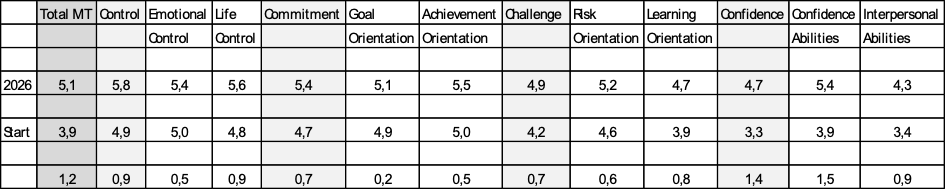
The team’s average score was more than one point higher than in the first measurement. The team profile showed the biggest improvement in the components of confidence in abilities, interpersonal confidence, life control and learning orientation.
In professional football, there are a lot of transfers in a year. Some players, who were enthusiastically taking part in the coaching program, left the club and joined a.o. Ajax and Fiorentina. When we focused on the individual players, we noticed that the players who left the team were, on average, and except for the players who left for a better club, more mentally sensitive than the players who stayed. Mental toughness, identified with the MTQ, was one of the criteria in the selection process for new players to the team. We saw that, on average, the newcomers were more mentally strong.
The players that were part of the journey from the beginning showed improvement that was, on average inline with the overall team. The staff and I concluded that players who adopted mental toughness interventions in their lives and training showed improvement. Players who were not so actively involved showed almost no progress.
The approach works. But a lot of convincing and perseverance was en is still needed. It also shows that mental toughness develops when you are and remain structurally engaged in it, both individually and collectively.
“We couldn’t have done that last year!”
Mental toughness often makes the difference between winning and losing in top sport. A player said at the beginning of this season, after we had won two games in the last minutes: “We could never have done that last year.” And that’s right. That is exactly the reason why we put time and energy into the development of mental toughness at FC Utrecht.
