
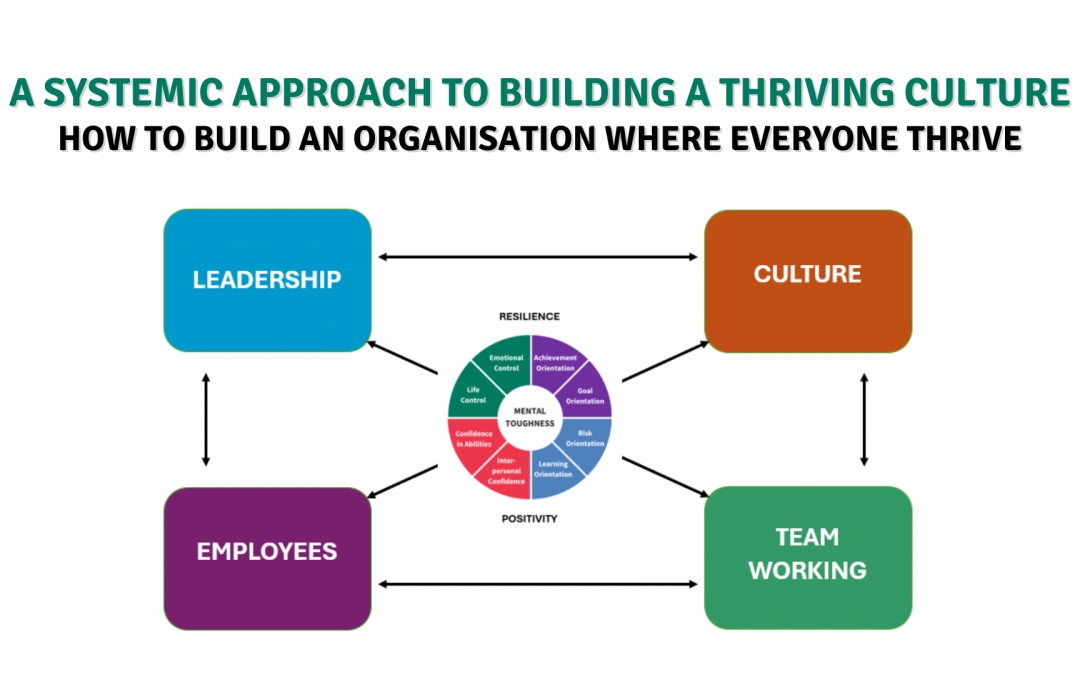
HOW TO BUILD AN ORGANISATION WHERE EVERYONE THRIVES
THE MENTAL TOUGHNESS CONCEPT CAN BE THE KEY TO A SYSTEMIC APPROACH TO ENABLE ORGANISATIONS AND THEIR PEOPLE THRIVE.
There are several reasons why culture has been overlooked in individual and organisational development.
Firstly, many do not understand it well enough to work on it. Practitioners of all types and leaders focus on leadership, individual and team development and pay little attention to context whilst achieving moderate, often short-term, success. But context matters. A systemic approach becomes the “holy grail” of development.
So, what is culture? A simple explanation is to understand it as the behavioural personality of the organisation. In the same way that behavioural personality represents a person’s default responses to events, that is, they respond without needing to think too much about it, culture is the same for the organisation.
It describes how the organisation responds to events when no one is telling its people how they should respond at that point in time. That is, the organisation’s default response.
Organisational culture can embrace a number of features, including values, the nature of its purpose, leadership style, economic and social factors, the market, and the way that employees are motivated and engaged in contributing to the organisation.
It almost always embraces two desired features, Resilience and Positivity, that are core elements of Mental Toughness. Resilience to be able to deal with adversity and setbacks. Positivity to be optimistic about what lies ahead and have the self-belief to manage this.
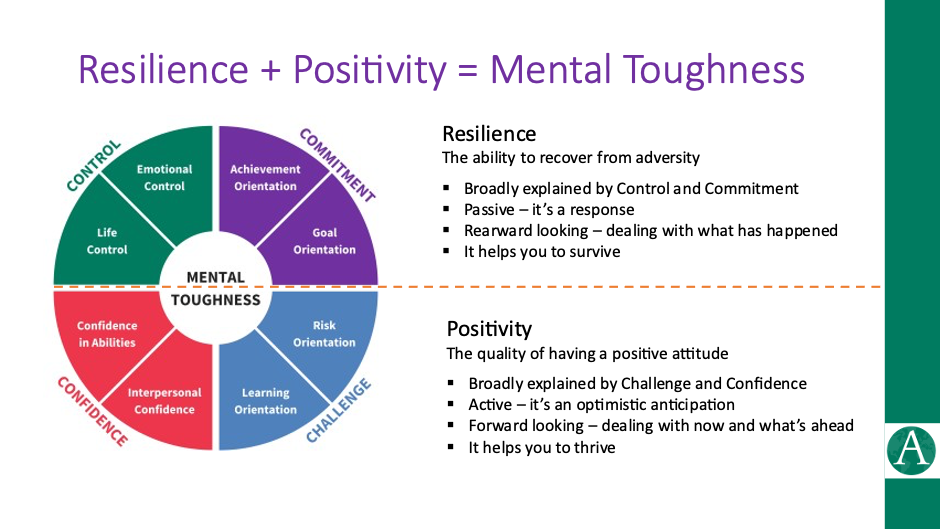
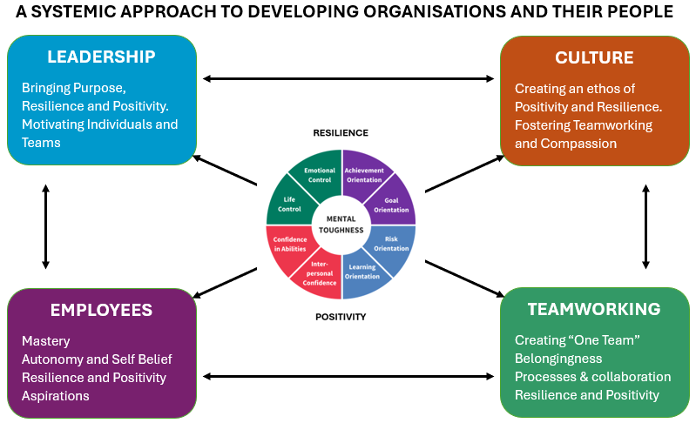
Culture is an outcome of the leadership of the organisation. Leadership is about motivating people and teams to give their best effort. For Leadership, resilience and positivity are just as important. Both for performing the role and setting the cultural features for followers.
For the follower, the employee, these are also important – both for their ability to contribute to performance as well as to be able to do this without detriment to their mental health.
For the follower, another cultural feature is important – teamworking. Collaborating to optimise everyone’s contributions is a contributor to achieving a worthwhile purpose. Resilience and Positivity are just as important for teams.
As consultants, coaches and practitioners as well as organisational leaders, we will tend to be involved in attending to each of these areas, but not always in a coordinated or systemic way.
Each area will have its unique features, which means they will need a customised approach if they are to be optimised. However, they are also interconnected through a fundamentally important concept – mental toughness – that underpins each.
Mental toughness explains how individuals and groups respond mentally – in their heads – to the plethora of situations that organisations and their people face. This includes managing adversity, setback, failure and change as well as optimising opportunity, challenge and developing innovation and creativity.
These are all behavioural outcomes that are also enablers that lead to the ultimate outcomes we associate with performance and wellbeing. And underpinning each is mental toughness – a core enabler.
We can summarise the connections and the interplay between them, and how the mental toughness concept can anchor a systemic approach below.
Usefully too, the development of normative measures, MTQPlus and MTQ4Cs, brings the capability for a data-based approach to this co-ordinated approach. We can assess and measure what we do.
It costs nothing to know more. It could be a game changer.
