
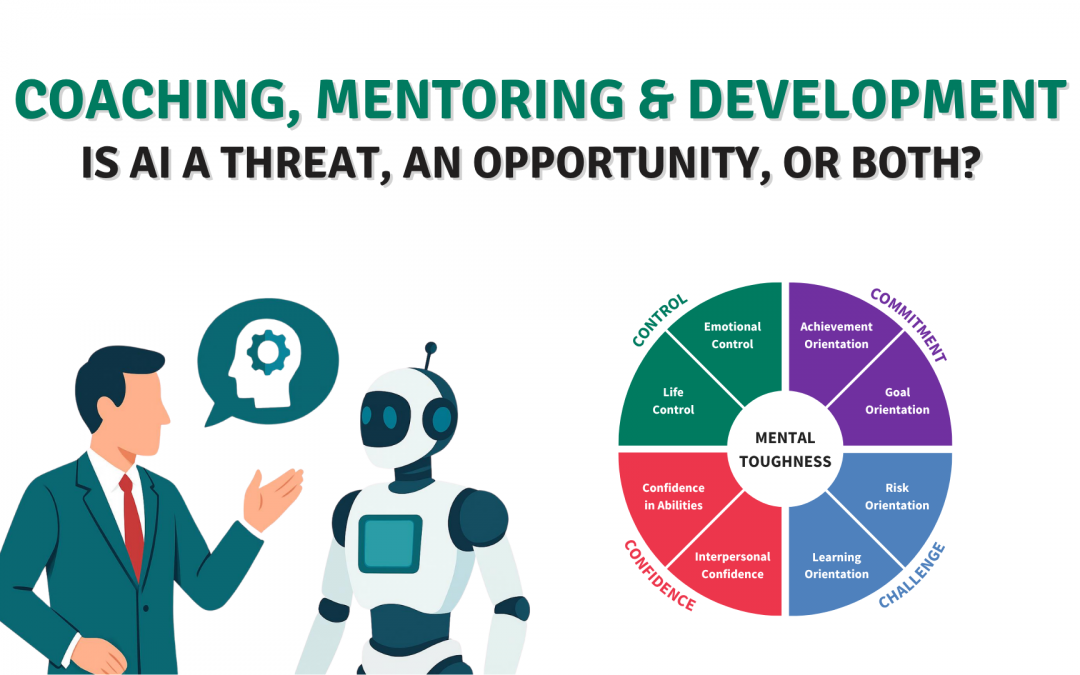
In 2025, in our Talking Toughness podcasts, we spoke with coaching thought-leaders, Jonathan Passmore and David Clutterbuck, about Coaching and AI, and its impact on practitioners who work in people, team and organisation development.
They saw that coaching and associated disciplines will experience a fundamental and dramatic change. Indeed, both commented that it was already underway.
In 2023, Dr William Fleming at the Wellbeing Research Centre, Oxford University, found that, in a study on 233 wellbeing programmes, “results suggest interventions are not providing additional or appropriate resources in response to job demands.”
They are connected.
The Oxford Study looked at 233 wellbeing and resilience programmes, some delivered through coaching, and found them wanting. The reason? A lack of customisation and a tendency to use one-size-fits-all (OSFA) approaches. That should not surprise anyone. Research generally supports this.
Customisation means adapting something to suit a particular individual. It means responding to their specific needs. Not treating someone as a type, a colour, or a label.
People are unique, complex, and they work in complex situations. Their needs are specific to them and must be addressed as such.
Our coaching thought-leaders make a similar point. Too much coaching practice is prescriptive, driven by simple processes. GROW is one example. Too much exploration is superficial, but not where that behaviour comes from. That requires digging deeper into the client to understand all that influences their behaviour. Simple ipsative measures such as MBTI, Insights and DiSC do not cut it.
Now… AI loves simple processes like GROW and is capable of developing generic solutions with a stock of scripted questions. AI can do this faster, better, and cheaper than most coaches who operate at this basic level. For them, AI is a threat.
But this basic level does not really cut it either. Customisation is key. When people go to a coach or enter any development process they want, firstly, to understand WHY they are responding to situations the way they do. You can only help to find solutions once you have an answer to that question.
Moreover, the answer is complex and will embrace what the person brings to the situation (abilities, interests, motivation), their environment (culture, resources, demands) and, importantly, their invisible default mental responses to life and to work.
The Mental Toughness concept addresses this last point, which also connects all three because, not only is it a direct influence on behaviour, it also influences all the other factors which shape behaviour. A well-evidenced personality trait, it explains a person’s mental responses to events.
There are 8 independent factors contributing to a person’s mental toughness, providing over 40,000 combinations of profile, which are multiplied when they interplay with other factors. The MTQPlus psychometric helps users to identify those profiles.
Now, true customisation is achievable.
And AI can now support the opportunity. Some of the complexity can be managed with the adoption of AI. Processing core data is its meat and drink. The rest will need the contribution of a curious coach.
Helping individuals to control their challenges, to become self-aware about why they respond to things the way they do and to find solutions that optimise their lives and their wellbeing with this kind of deep insight is likely to be best provided through human connection.
For the coach who wishes to remain relevant in the face of AI, elevating their practice is a must.
