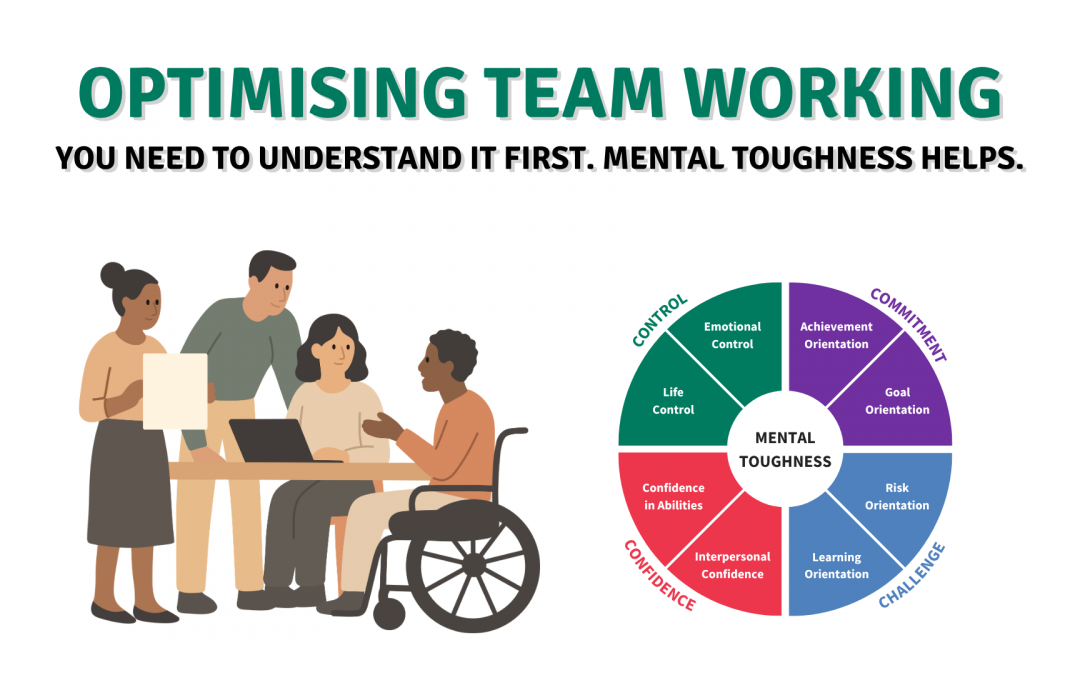
Optimising Team Working – You need to understand it first. Mental Toughness really helps.
Optimising Team Working is important. Arguably, it is the core challenge for leadership. As Tomas Chamorro-Premuzic puts it: “can you convince people to collaborate effectively to accomplish a common goal; can you persuade people to set aside their individual … instincts so they can achieve something they would not be able to achieve individually”.
Mostly, team building programmes are enjoyable, but evidence for their impact is limited. Mostly, they focus on behaviour. They explore what the team is doing and what the team members are doing. Often in two dimensions – does this behaviour help the team processes to function, and is the behaviour such that people help and support each other?
Some of this is useful. A lot is not.
The key question begins with “why”. Why does this team function the way it does? That means exploring where behaviour comes from. That’s where mental toughness comes in.
The solution is often found by asking “how…”. To respond, you need the answer to “why…”.
There are two perspectives to consider: the individual and the collective.
The mental toughness concept and the MTQPlus psychometric provide the lens through which this can be understood and assessed. The MTQPlus is a normative measure, which means it can do something that ipsative measures, such as MBTI, Insights, or DiSC, cannot. You can measure before and after to monitor and evaluate. Bringing data-based practice into play.
For each team member, self-awareness about their mental toughness profile provides a deep insight into why they respond mentally to what happens in the team and why that impacts their own behaviour. Particularly in terms of the way they approach other team members. What can they do to optimise that?
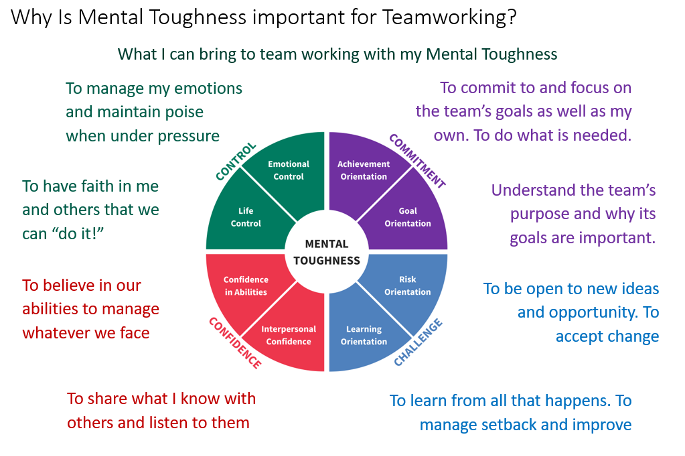
Sharing this information for all team members (and it is accepted that that may not always happen) taps into some really valuable information. I can now understand how others approach our team tasks in their minds and how I am perceiving the way they see me, and understand where my behaviour comes from, and I see them and understand where their behaviour comes from.
This provides a fundamental insight into why we respond to each other the way we do and where that can be optimised.
Now there is potential to find a robust solution.
Usefully, it is possible to aggregate the mental toughness profiles for the team and create a team profile. This creates a picture of the team as an entity. The profile across the 8 factors will guide users in understanding what the team might be good at doing and less good at doing.
Most teams have team members who, for one reason or another, have a unique contribution. They might be the leader, or they might bring special skills or knowledge to the team.
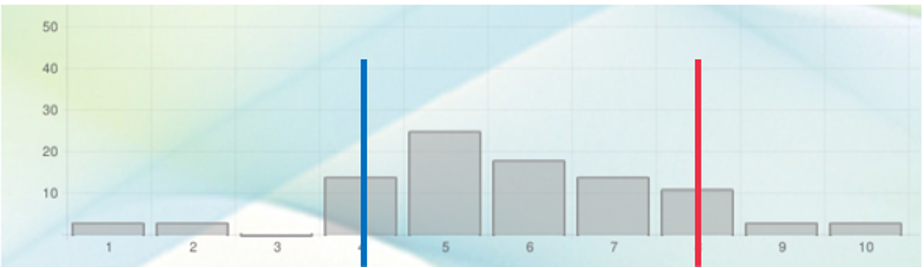
Considering where that individual profile sits in relation to the team can be a powerful insight. They may have a special skill, but they could be ignored (as we have seen this more often than we expect). The leader might have a level of mental sensitivity or toughness on a factor that is higher or lower than the rest of the team. What can this explain?
Chamorro-Premuzic is correct. Collaboration matters. Optimisation means optimising the contributions each individual makes as well as optimising the way team members interact to optimise each other’s contributions.
To do this, you need to dig deeper than simply looking at behaviour.
