
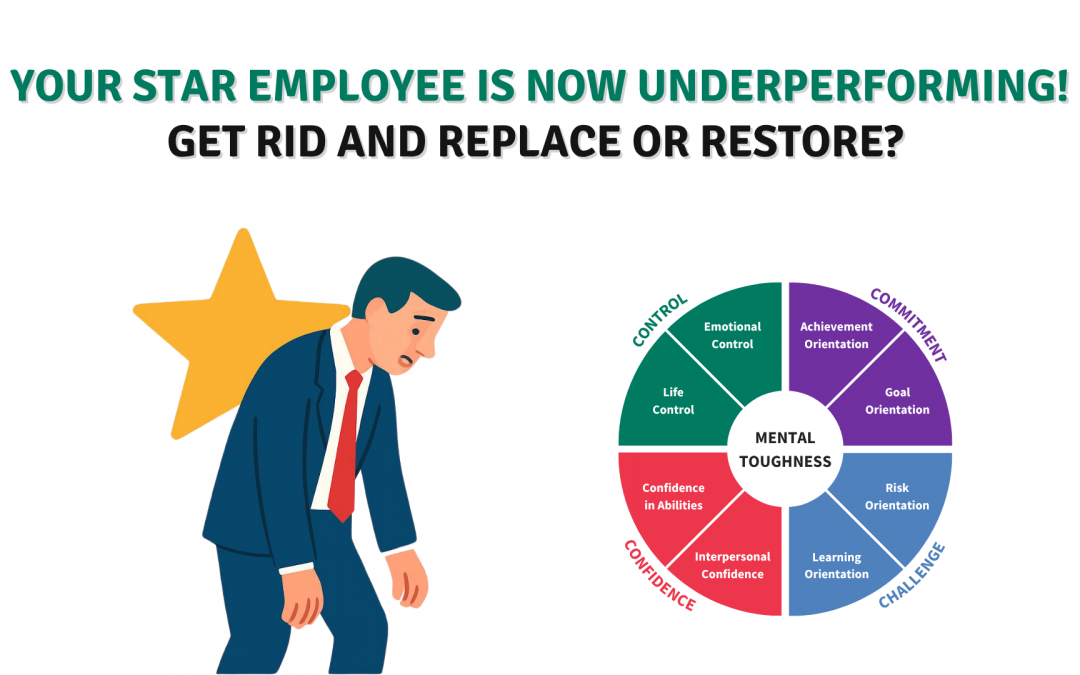
Get rid and replace or restore your underperforming employee? The mental toughness concept might just guide you to the best solution for everyone.
It can be anyone who was once doing a good job and is now struggling. The cost of recruiting a replacement is fraught with uncertainty and risk. In today’s world, the ability to recruit great people is more challenging than ever before. The underperforming employee you lose very often has a great deal of the skills and knowledge that the organisation needs. They take that with them. It can be more effective to restore that employee than to replace them.
If the underperforming employee has performed well in the past, it is worth exploring that invisible aspect of personality – mental toughness – that deeply influences behaviour and the outcomes the organisation is looking for. There has to be a reason for the decline in performance. If you know what that is, you may be able to do something about that.
Reasons could include burnout, loss of motivation and interest, diminishing self-belief, anxiety and fear, and so on. They all reflect a person’s mental approach to their life and their work. These are all capable of being restored.
A good employee doesn’t just bring their skills, knowledge and experience to their role and to the organisation, they also bring their mental approach to their work. This is a major component of what is often described as attitude. This is what the mental toughness concept describes in detail, enabling users to understand how this can explain underperformance.
What is mental toughness?
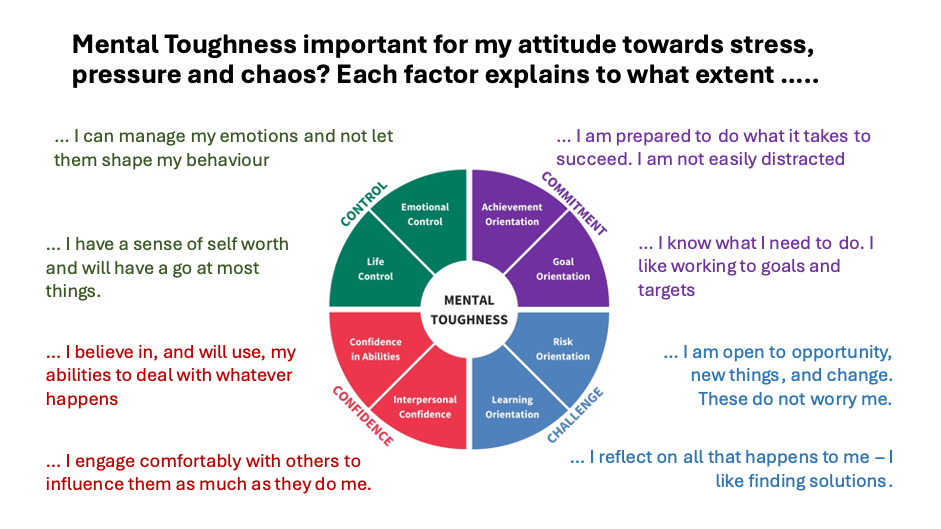
The mental toughness concept is a very well-evidenced personality trait that explains how we respond mentally to stressors, pressure, opportunity and challenge. All are capable of diminishing someone’s performance and wellbeing.
Importantly, we can assess it confidently to understand an underperforming employee’s responses and, in most cases, explain their behaviour, performance and wellbeing.
This provides a platform for a good employer to support their employees. It’s a process that is well understood, often adopted through coaching and mentoring – provided you identify what needs attention. It’s an approach worth considering for the wellbeing of all employees carrying out challenging roles.
And there are big benefits in doing this:
- The employee feels the care and compassion influencing their motivation.
- Other employees recognise and value this
- It becomes a cultural feature adopted by the organisation’s leadership.
- It’s much less time-consuming and less expensive than replacement.
It’s what Talent Management should address. You have talent, optimise it!
